

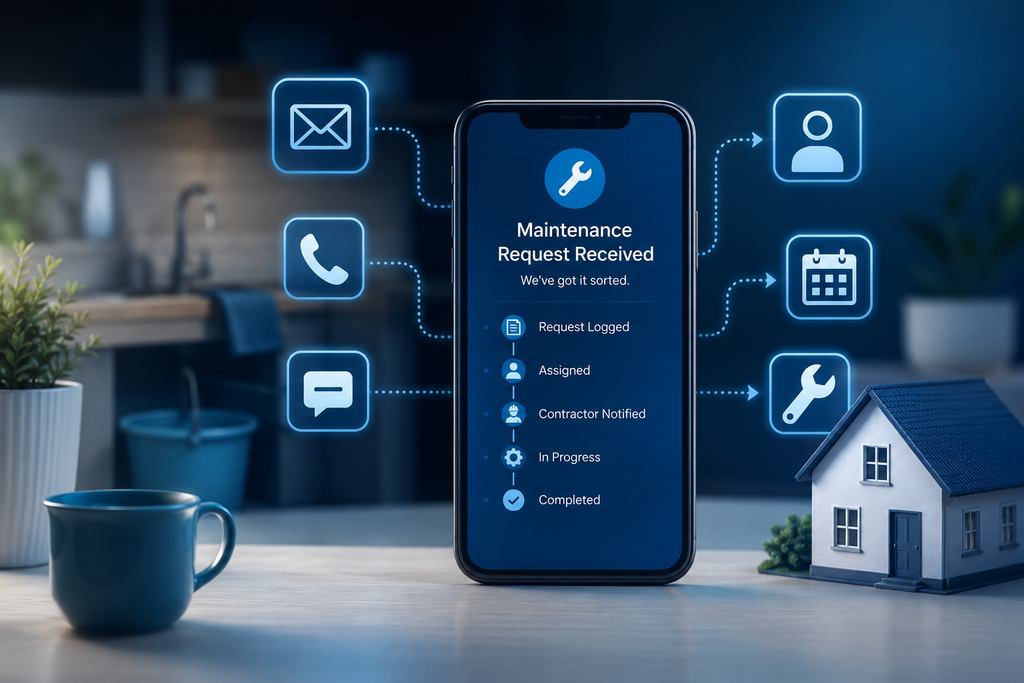
A tenant doesn’t ring about a leaking tap because they want a chat. They ring because they’re standing in a kitchen with a bucket and nobody’s told them what happens next.
That’s what most property managers get wrong about property maintenance automation. They worry it’ll feel cold. What actually feels cold is silence for four days, then a one-line email from someone clearly juggling sixty other things. Automation doesn’t cause that. Bad process does. The right repairs and maintenance software, built properly, is usually the fix.
The real problem is the silence, not the system
The damage to a tenant relationship rarely happens during the repair. It happens beforehand. A request lands by email, portal, or voicemail, sometimes all three. Someone has to notice it, judge how urgent it is, find a contractor, check availability, reply. If that person is also handling twelve other properties, the gap stretches from hours into days.
Tenants don’t read that gap as “the business is busy.” They read it as “nobody’s bothered.” That’s the personal touch you’re actually losing, and manual handling of maintenance requests is usually why.
Tenants want certainty more than warmth
Most tenants would rather get an instant, accurate update from a system than wait two days for a sympathetic voice that still can’t tell them when the plumber’s coming. “We’ve logged this, a contractor’s assigned, expect contact within 4 hours” sent the moment a request lands does more for the relationship than a warm call that arrives after they’ve already rung twice more to chase.
That’s not an argument for removing people. It’s an argument for putting them where they’re actually needed, and using AI automation for property management to close the gap they can’t physically close on their own.
What to automate, and what to leave alone
Automate: intake and logging into one place, triage against a severity rule-book, contractor routing by trade and availability, automatic status updates, and a post-completion check-in.
Keep human: ambiguous or distressing situations, complaints or disputes, anything involving vulnerable tenants, and the first call on genuine emergencies.
Automate the coordination. Keep the judgement human.
What this looks like, built
A request comes in through any channel and lands in one system. Rules check it against a severity list: no heating, no hot water, or water damage gets flagged urgent and routed straight to a person for a same-day call. Everything else gets logged and matched to a pre-approved contractor.
The tenant hears back within minutes, not generic “request received” filler, but something specific: what’s logged, roughly when to expect contact, how to flag if it worsens. When a contractor accepts, the tenant’s told who’s coming and roughly when. After the job’s done, a short check-in asks if it’s actually sorted, not just closed on a spreadsheet.
The property manager isn’t cut out of this. Everything’s visible in one place, urgent cases still land on their desk, and they’re no longer manually chasing three contractors on a Tuesday afternoon. This is what workflow automation UK property managers are increasingly turning to actually solves: less admin, faster resolution, no drop in service.
Keeping it human once it’s running
Build an obvious escalation path. If a tenant replies “this isn’t right,” that goes straight to a person, not back into the loop.
Review severity rules regularly. What’s urgent in January isn’t what’s urgent in June. Stale rules mean a burst pipe gets called standard priority, which is worse than no automation at all.
Write the messages like a person wrote them. This is the one businesses skip, and it undoes half the benefit of any tenant communication automation when they do.
The takeaway
The personal touch was never about who answers the phone. It’s about a tenant knowing someone’s on it. Done properly, property maintenance automation is what makes that possible at scale, and it frees your time for the calls that genuinely need a human.
If you’re finding out about a repair the same time the tenant’s third chase-up email lands, that’s not a staffing problem. That’s a process one.
We build this kind of automation for property management companies across Bracknell, Reading, Wokingham and the wider Thames Valley, as well as remotely for SMEs across the UK. The AI Readiness Audit is a free 45-minute call. We look at how maintenance requests actually move through your business, and you get a written PDF report either way. No pitch attached.